


Vitamins: Exploring the Fundamentals of Skin Health
Have you ever wondered what role vitamins play in maintaining skin health? The names vitamin A, C, and E may be familiar, but how they contribute to skin health can be cryptic. The good news is, maintaining proper levels of vitamins through your diet is a simple and effective way to give your skin a boost from the inside out.
____________________________________________________
Vitamin A

When it comes to vitamin A, the key to well-nourished skin is balance. It is essential for hair growth and healthy skin, but too much can lead to hair loss and reduced sebaceous gland function. A good amount to aim for is 700 micrograms per day for women, and 900 micrograms per day for men. When you’re looking to increase your vitamin A intake, look for baked sweet potato, spinach, and carrots.
_____________________________________________________
Vitamin C

When you think of vitamin C, citrus fruits may be the first thing to come to mind. It's true that they are a great source of vitamin C, and so are red and green peppers, as well as broccoli. Humans are unable to synthesize vitamin C, so it's very important to reach the daily recommended intake of around 90-120 milligrams for adults. Vitamin C is required for the synthesis of collagen, which is vital to skin firmness and structure. It also acts as an antioxidant, which has anti-inflammatory properties and reduces oxidative stress—a cause of collagen breakdown. If collagen breakdown is a concern, collagen supplements are also a great enhancement option.
_____________________________________________________
Vitamin E
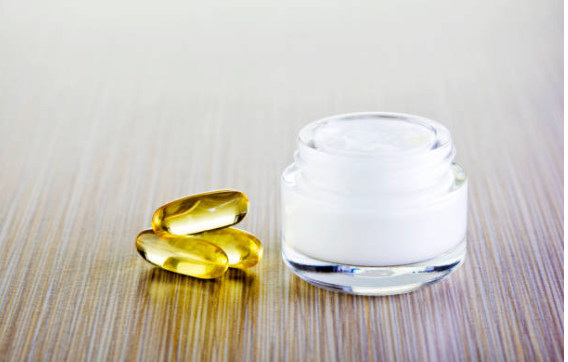
The key feature of vitamin E is its role in protecting the skin. It is also an antioxidant, and is involved specifically in stopping the formation of reactive oxygen species that are typically formed when fat undergoes oxidation. As with vitamin C, this is vital to preventing collagen breakdown and maintaining firm skin. Vitamin E is secreted onto the skin in sebum, where it can penetrate into all underlying layers of the skin. It offers partial protection against sunlight, absorbing UVB rays. Studies have shown that vitamin E supplementation alone may have limited effects on sun protection, but the combination of vitamin E and C together have increased photoprotective properties, showing lower amounts of DNA damage after UV exposure. However, vitamin E that is applied topically has increased photoprotective effects. It is important to remember that even when applied topically, vitamin E does not replace sunscreen, since UV rays are also composed of UVA! The recommended intake is 15 milligrams per day, and this vitamin can be found abundantly in sunflower seeds, and is also present in a variety of nuts such as almonds, hazelnuts, and peanuts.
_____________________________________________________
Vitamin D
Interested in learning about vitamin D and its role in skin health? Check out the blog on Vitamin D and Sunlight!
_____________________________________________________
How To Incorporate These Vitamins Into Your Diet
To maintain proper levels of these skin-boosting vitamins, the best strategy is to focus on a diverse, whole-food diet. Multi-vitamins and vitamin-specific supplements are also a good addition, especially if it is difficult to obtain specific vitamins in your region—such as vitamin D during the winter for those who live far from the equator.
_____________________________________________________
Reminder: More Isn't Always Better
Some vitamins are lipid soluble, and can build up in your liver if taken in excess. While you’d have to consume a very large excess of vitamins to experience toxicity, it's always a good idea to stay within the recommended range.
_____________________________________________________
Final Thoughts
Maintaining proper vitamin levels is essential for a healthy body, with direct results shown through your skin. Make sure you’re eating a balance of vitamin-rich food and taking vitamin-specific supplements or a multivitamin if your diet can’t provide enough vitamins. A little daily attention to your nutrition goes a long way in keeping your skin glowing!
Disclaimer: This blog provides general health information and does not provide medical advice. Please consult your health care provider for any medical concerns.
Citations
VanBuren, Christine A., and Helen B. Everts. “Vitamin A in Skin and Hair: An Update.”
Nutrients, vol. 14, no. 14, 19 July 2022, p. 2952, https://doi.org/10.3390/nu14142952. Accessed 17 Nov 2025.
National Institutes of Health. “Vitamin A and Carotenoids.” Nih.gov, National Institutes
of Health, 2023, ods.od.nih.gov/factsheets/VitaminA-HealthProfessional/. Accessed 17 Nov 2025.
National Institute of Health. “Vitamin C.” National Institutes of Health, National
Institutes of Health, 26 Mar. 2021, ods.od.nih.gov/factsheets/VitaminC-HealthProfessional/. Accessed 17 Nov 2025.
NIVEA. “4 Antioxidant Benefits for Skin.” Nivea.co.uk, Beiersdorf, 6 Dec. 2021,
www.nivea.co.uk/advice/skin/what-do-antioxidants-do-for-skin. Accessed 17 Nov 2025.
“Vitamin E and Skin Health.” Linus Pauling Institute, 2 Jan. 2019,
lpi.oregonstate.edu/mic/health-disease/skin-health/vitamin-E. Accessed 19 Nov 2025.
National Institutes of Health. “Office of Dietary Supplements - Vitamin E.” Nih.gov,
2021, ods.od.nih.gov/factsheets/VitaminE-HealthProfessional/. Accessed 19 Nov 2025.


Comments